
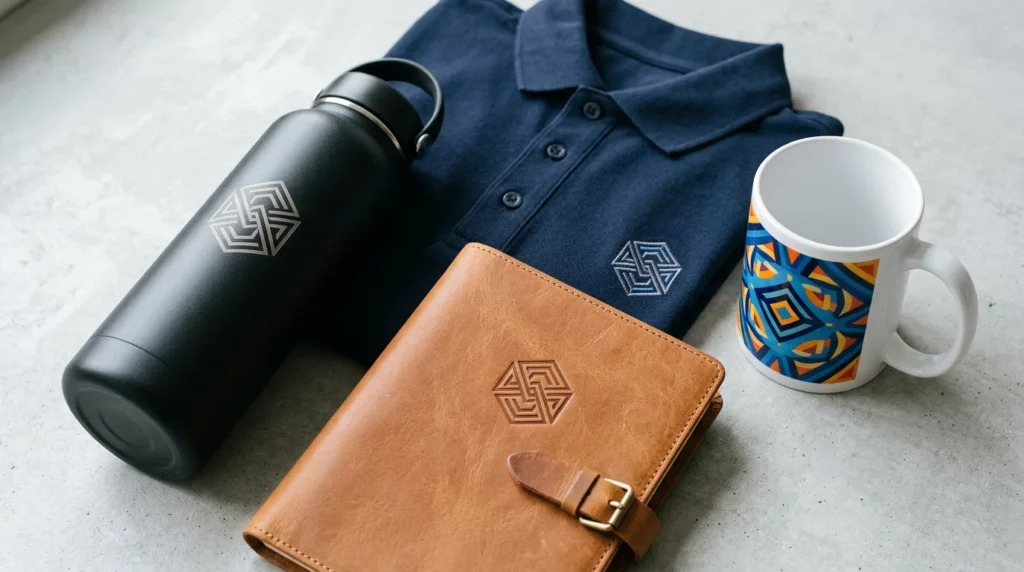
A great gift can look cheap with the wrong logo finish. A full-color logo cracks on a flexible bag, or fine text blurs on a cap. Most of these problems come from choosing the wrong method, not the wrong product. This guide compares the main logo printing methods, what each one does best, and how to pick the right one.
At Promotional.ae, we brand corporate gifts in Dubai every day. Working with these methods day in, day out shows us where each one shines and where it falls short.
The Short Answer
Choosing between logo printing methods starts with the material, then your logo:
- Metal, wood or glass: laser engraving
- Cotton bags and T-shirts: screen printing
- Full-color logos on hard, flat surfaces: UV printing
- White or light polyester and coated mugs: sublimation printing
- Polo shirts, caps and jackets: embroidery
- Leather and PU notebooks or organizers: debossing or embossing
- Pens and other small, curved items: pad printing or laser engraving
Logo Printing Methods at a Glance
| Method | Best for | Colors | Durability |
| Laser engraving | Steel bottles, metal pens, wood, glass | None (tone-on-tone mark) | Permanent |
| Screen printing | Cotton tote bags, T-shirts, large runs | A few solid colors | High |
| UV printing | Notebook covers, acrylic, gift boxes, hard plastics | Full color, including white | Good |
| Sublimation | White mugs, polyester apparel, lanyards | Full color | Permanent |
| Embroidery | Polo shirts, caps, jackets, bags | Thread colors | Very high |
| Debossing and embossing | Leather and PU notebooks, organizers | None, or foil | Permanent |
| Pad printing | Pens, stress balls, USB drives | Usually 1 or 2 colors | Good |
The Main Logo Printing Methods in Detail
Laser Engraving
A laser marks your logo directly into the surface, so there is no ink to fade, crack or peel. On powder-coated bottles, the laser removes the coating to reveal the steel underneath. On wood, it leaves a darker, burned mark. It is ideal for premium items such as metal pens, steel bottles and power banks.
The trade-off is color. Engraving gives a single tone that depends on the material, not your brand colors. It is also the easiest way to add individual names, because there are no screens or plates to change. Learn more about our laser engraving service.
Screen Printing
Screen printing pushes ink through a fine mesh screen, with one screen for each color. It gives bold, solid color and works best on fabric and other flat or round surfaces. Because each screen takes time to set up, it becomes more economical as quantities grow.
It is not the right choice for photos, gradients or very small runs. A one- or two-color logo on a few hundred cotton bags is where it shines. See our screen printing service for details.
UV Printing
UV printing applies full-color ink directly onto hard surfaces and cures it instantly with ultraviolet light. It can print white ink, so colorful logos still pop on dark materials. It can even create a slightly raised texture. That makes it a strong choice for notebook covers, acrylic awards, gift boxes and hard plastics.
UV printing needs no screens, so small orders and personalized names are practical. On items handled all day, the print can wear over time, so engraving may last longer on metal. Explore our UV printing service.
Sublimation Printing
Sublimation uses heat to turn special ink into a gas that bonds with polyester fibers or a polymer coating. The design becomes part of the material, so it will not crack or peel. It produces rich, full-color results, including photos.
There are two firm limits. It only works on polyester or specially coated items, such as sublimation mugs. It also needs a white or light background, because the ink is transparent. It will not work on cotton or dark fabric. Read more about our sublimation printing service.
Embroidery
Embroidery stitches your logo with thread, giving a textured, professional finish that lasts through many washes. It is the standard for polo shirts, caps, jackets and uniforms. Your logo is first converted into a stitch file, a one-time step called digitizing.
Cost depends mainly on the stitch count, which grows with logo size and detail. Gradients, very small text and thin lines do not stitch well, so simple logos work best. Visit our embroidery service page.
Debossing and Embossing
A metal die presses your logo into the material (debossing) or raises it above the surface (embossing). It uses no ink, so the result is subtle and elegant. For extra impact, a gold or silver foil can be added, which is called foil stamping.
This is the go-to finish for leather and PU notebooks, organizers and card holders. It suits executive gifts where an understated look feels more premium. Find out more about our emboss printing service.
Pad Printing
A soft silicone pad picks up ink from an etched plate and presses it onto the item. Because the pad bends, it can print on small, curved or uneven surfaces. That is why it is often used on pens, stress balls and USB drives.
It works best with one or two solid colors. On items that are handled constantly, the print can wear over time. For metal pens, laser engraving is often the longer-lasting choice.
How to Choose the Right Method: 5 Questions
These five questions narrow the logo printing methods down to one or two options.
- What is the item made of? The material rules out most options straight away. Polyester points to sublimation, metal to engraving, and leather to debossing.
- How many colors are in your logo? One or two solid colors work with every method. Gradients and photos need UV printing or sublimation.
- How many pieces do you need? Screen printing gets cheaper per piece as quantities grow. UV printing and engraving are better for small runs.
- How heavily will it be used? For bottles, pens and bags used daily, choose engraving, embroidery or sublimation for the longest life.
- Do you need individual names? Laser engraving and UV printing make personalization simple, because nothing needs to be remade for each name.
How to Prepare Your Logo for Printing
Good artwork saves time and gives a sharper result. Before you order, check these points:
- Send a vector file. AI, EPS, PDF or SVG files stay sharp at any size. A small JPG copied from a website rarely works.
- Share your Pantone colors. Pantone (PMS) codes help match your exact brand colors in screen and pad printing.
- Have a one-color version ready. Engraving and debossing show a single tone, so a solid one-color logo gives the cleanest result.
- Avoid tiny details. Very thin lines and small text can fill in or disappear, especially in embroidery.
- Always approve a mockup. A digital mockup shows the size, position and colors before production starts.
Ordering for a busy season? Our UAE corporate gifting calendar shows when to order for each occasion.
Common Mistakes to Avoid
Most disappointing results with logo printing methods come from a few avoidable mistakes:
- Choosing embroidery for a detailed logo with gradients or fine text.
- Ordering sublimation on cotton or dark polyester, where it cannot work.
- Using screen printing for a run of 20 pieces, when UV printing or engraving would cost less.
- Printing a full-color logo on a heavily used metal bottle, when engraving would last longer.
- Skipping the mockup, then finding the logo is too small or in the wrong place.
Want to compare more finished products before you decide? Our sister company has a wide corporate gift catalogue at Advertising Point, with many items shown in their branded finish.
Frequently Asked Questions
What is the most durable logo printing method?
Laser engraving and debossing are the most durable, because they change the surface itself and use no ink. Sublimation and embroidery are also very long-lasting. Surface prints such as pad printing and UV printing can wear on items handled every day.
Which printing method is best for a full-color logo?
UV printing is best for full-color logos on hard surfaces like notebook covers, acrylic and gift boxes. Sublimation is best for full color on white polyester and coated mugs. Screen printing can handle several solid colors, but not photos or gradients.
Can sublimation print on cotton or dark fabric?
No. Sublimation only bonds with polyester fibers or polymer-coated items, and it needs a white or light background. For cotton or dark garments, screen printing or embroidery is the better choice.
What file format do I need for logo printing?
A vector file in AI, EPS, PDF or SVG format gives the best result, because it stays sharp at any size. If you only have a PNG or JPG, send the highest resolution you have. Your supplier can then check whether it is usable.
Is laser engraving or UV printing better for metal bottles?
Laser engraving is better if you want the longest-lasting, premium finish, but it shows only a single tone. UV printing is better if your logo must appear in full color. For bottles used every day, engraving usually holds up longer.
Which method is best for adding individual names to gifts?
Laser engraving and UV printing are the most practical, because each name can be changed digitally without new screens or plates. Engraving suits metal and wood, while UV printing suits hard, flat surfaces.
Not Sure Which Method Fits Your Gift?
Comparing logo printing methods is easier with a second opinion. Tell us the product, quantity and logo you have in mind, and we will recommend the method that looks best and lasts longest within your budget. Browse the full range at Promotional.ae or get in touch to request a mockup.