
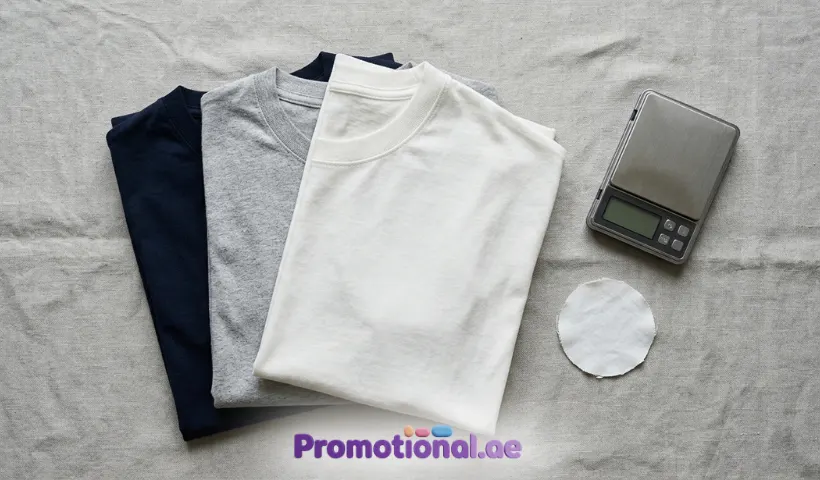
Two white T-shirts can look the same in a product photo and feel nothing alike in your hand. One turns see-through after a few washes. The other still looks sharp at next year’s team day. Most of that difference comes down to one number on the spec sheet: the T-shirt GSM.
We print and embroider shirts in-house as a corporate gifts supplier in Dubai. This is the advice we’d give anyone ordering branded T-shirts for the first time.
What Does GSM Mean on a T-Shirt?
GSM stands for grams per square meter. It tells you how much one square meter of the fabric weighs. A higher number means a denser, thicker fabric. So a 180 GSM shirt feels heavier and less see-through than a 140 GSM one.
GSM measures weight, not quality, though. A well-made 150 GSM shirt in combed cotton can feel nicer than a rough 200 GSM one. The yarn and the knit matter too.
Some brands list fabric weight in ounces per square yard instead. To convert, multiply the ounces by about 34. For example, a 5.3 oz shirt is roughly 180 GSM.
T-Shirt GSM Chart
Here is how the common T-shirt GSM ranges compare:
| GSM | Weight class | How it feels | Good for |
| 140 to 160 | Lightweight | Thin and airy, and white shirts may show through | Outdoor events, fun runs, one-day giveaways |
| 160 to 180 | Light to midweight | Soft and breathable, the everyday standard | Conferences, team events, staff T-shirts |
| 180 to 200 | Midweight | Holds its shape and is not see-through | Uniforms and shirts people will keep |
| Over 200 | Heavyweight | Thick, structured and premium | Merchandise, cooler months, oversized fits |
Polo shirts use a different knit, called pique, so their numbers run higher. Most start around 180 GSM, and 200 to 220 GSM is a common midweight.
If you only remember one number, make it 180. It works for most staff shirts, it takes printing well, and it does not go see-through.
Picking a T-Shirt GSM for the UAE Climate
Our weather changes the answer more than most guides admit.
For outdoor events between May and September, go light. A 140 to 160 GSM cotton shirt keeps people cooler. For sports days or runs, a moisture-wicking polyester shirt is even better, because it dries fast.
Office uniforms are different. People wear them in air-conditioning and wash them every week. So a 180 to 200 GSM shirt makes more sense here, because it looks neater and lasts longer.
Winter is the third case. For desert camps or evening events from December to February, a heavier shirt over 200 GSM or a hoodie feels right. Hoodies usually sit somewhere between 280 and 350 GSM.
One more tip for white shirts: avoid the lightest weights. Under about 160 GSM, white cotton often shows what is underneath, especially in bright light.
Fabric Type Matters as Much as Weight
Two shirts with the same T-shirt GSM can behave very differently. The fiber is the reason.
100% cotton is soft and breathable, and it works with every printing method. But it holds sweat and dries slowly. It can also shrink a little, so ask for pre-shrunk cotton. Combed or ring-spun cotton feels smoother than standard cotton.
Polyester, often sold as quick-dry or moisture-wicking fabric, dries quickly and barely shrinks. It is very durable, although some people find it less comfortable than cotton. It suits sports and outdoor work.
Cotton and polyester blends sit in the middle. They feel soft, shrink less than pure cotton and are easy to care for. You will often see them listed as CVC, which means the blend contains more cotton than polyester.
How GSM Affects Your Logo
Your T-shirt GSM also changes which branding method gives the best result:
- Screen printing works on every weight. On cotton, a midweight shirt gives a smooth, even print. Read more about our screen printing service.
- Embroidery works best on fabric above about 180 GSM. On thin shirts, the stitches can pull and pucker the fabric, unless a backing is added. That is why polo shirts are the usual choice for an embroidery
- Sublimation only works on polyester in white or light colors. Here the weight matters less than the fiber. See our sublimation printing page for details.
For the full comparison, read our guide to logo printing methods.
How to Check GSM Before You Order
A listing that says “premium cotton” tells you very little about the real T-shirt GSM. Ask for these three things instead:
- The spec sheet. It should state the GSM, the fabric composition and whether the cotton is pre-shrunk.
- A physical sample. Feel it, wash it once and hold it up to a window. If you can clearly see your fingers through one layer, it will look thin when worn.
- A size chart in centimeters. Then compare it with a shirt that already fits you well.
Factories check GSM with a round cutter that removes exactly 100 square centimeters of fabric. They weigh that piece and multiply by 100. So a sample that weighs 1.8 grams is 180 GSM. A kitchen scale is not precise enough for this, because you need a scale that reads to 0.01 grams.
Don’t Forget Sizing
Fabric weight gets the attention, but sizing is why many company shirts never get worn. Collect sizes from people before you order instead of guessing. Also offer a women’s fit if your team needs it. A shirt that fits well gets worn on weekends too, and that is free advertising for your brand.
Quick Recommendations
This is the T-shirt GSM we’d pick for each situation:
- One-day summer event outdoors: 140 to 160 GSM cotton, or polyester for sports.
- Indoor conference or team event: 160 to 180 GSM combed cotton.
- Staff uniform worn every week: 180 to 200 GSM T-shirt, or a 200 to 220 GSM polo with an embroidered logo.
- Premium merchandise or winter events: a T-shirt over 200 GSM, or a hoodie.
You can browse our polo shirts and T-shirts to compare styles and colors.
Frequently Asked Questions
What is a good GSM for a T-shirt?
For most staff and event shirts, 160 to 180 GSM is a good choice. It feels soft, breathes well and is not see-through. Choose 180 to 200 GSM for uniforms that are washed often, and 140 to 160 GSM for hot outdoor events.
Is a higher GSM T-shirt always better?
No. A higher GSM shirt is thicker, more durable and less see-through, but it is also warmer. Quality depends on the yarn and knit as well. A well-made 160 GSM shirt can feel better than a cheap 200 GSM one.
What T-shirt GSM is best for hot weather in the UAE?
A 140 to 160 GSM cotton shirt is the most comfortable choice for outdoor summer events. For sports or physical work, a moisture-wicking polyester shirt is better, because it dries quickly.
What GSM should a polo shirt be?
Most polo shirts are between 180 and 220 GSM, and 200 to 220 GSM is a common midweight. This weight holds an embroidered logo well and keeps the collar looking neat.
How do you measure the GSM of a T-shirt?
Cut a round sample of exactly 100 square centimeters with a GSM cutter, then weigh it on a precise scale. Multiply the weight in grams by 100 to get the GSM. For example, a 1.8 gram sample means 180 GSM.
Can you embroider a logo on a lightweight T-shirt?
Yes, but there is a risk. On fabric under about 160 GSM, embroidery can pucker unless a backing is added. For light T-shirts, screen printing usually gives a cleaner result.
Planning a T-Shirt Order?
Tell us where the shirts will be worn, how many you need and your brand colors. We will suggest the right T-shirt GSM and send a physical sample if you want to feel it first. We brand everything in-house, the digital mockup is free and there is no minimum order. Ready-stock shirts are usually branded within 24 to 48 hours, and delivery is free anywhere in Dubai.
If you’d like to compare more options, take a look at the corporate gift range at Advertising Point, our sister company. Otherwise, explore our full range at Promotional.ae or get in touch for a quote.